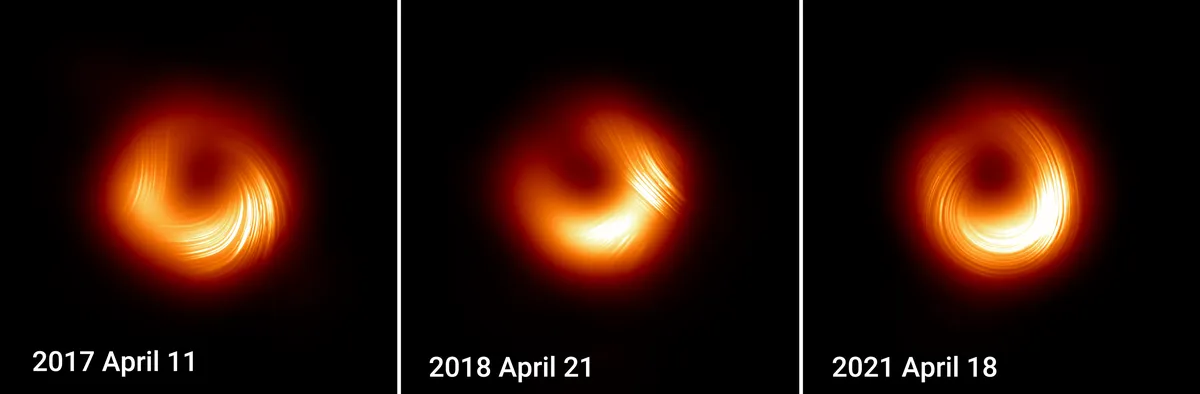
 Prettified polarization maps on horizon scales (by prettified I mean line integral convolution images, looks good!). From EHTC (2025).
New year, new science. Time to think about my favorite papers of 2025. This is of course a hugely biased list, convolved with my personal scientific preferences. This list will be focused on the topics of black hole astrophysics.
<h2 id=phenomenology-agns-little-red-dots>Phenomenology: AGNs, little red dots</h2><p>Not a terribly exciting year on the observational front for AGNs and black hole binaries. If you discount little red dots, that is.</p>
There were the polarization flips observed in M87* on horizon scales. Really hard work, and in my opinion polarization offers the biggest science lessons from EHT. No surprises in the polarization properties mapped. All variability is consistent with accretion physics expectations (good!).
Prettified polarization maps on horizon scales (by prettified I mean line integral convolution images, looks good!). From EHTC (2025).
For me, the biggest puzzle in polarization studies is the following. Sgr A* and M87* have basically the same polarization properties. The same GRMHD models explain the observations: a MAD around a rapidly rotating black hole with . So why the heck does M87 produce huge jets while Sgr A shows none of them?. If you feed such a Kerr black hole with lots of magnetic fields, you should get strong jets. What is special about Sgr A* then? And no, I do not believe in the evidence so far for jets from Sgr A*.
The hottest thing in the observational front right now—and honestly in all fields of astronomy—is the little red dot phenomenon. This is a transformational field where we know very little about what is behind those sources. Comparable to when quasars were discovered, or gamma-ray bursts. It is breath-taking and hard to catch up with so many papers being posted (about 200 since LRDs were discovered two years ago).
The top-2 results on LRDs this year were:
(1) High S/N JWST spectra of LRDs are better explained by exponential line profiles. This has huge implications because the line broadening we are seeing would be mostly explained by Thomson scattering in an optically thick, highly-ionized medium, not virial motion around a central mass. This is important evidence that LRDs are growing massive black holes enshrouded in a cocoon—which some authors are calling a “black hole star” (I hate that term, confusing on so many levels)—and they are not overmassive with respect to their galaxies as many authors think.
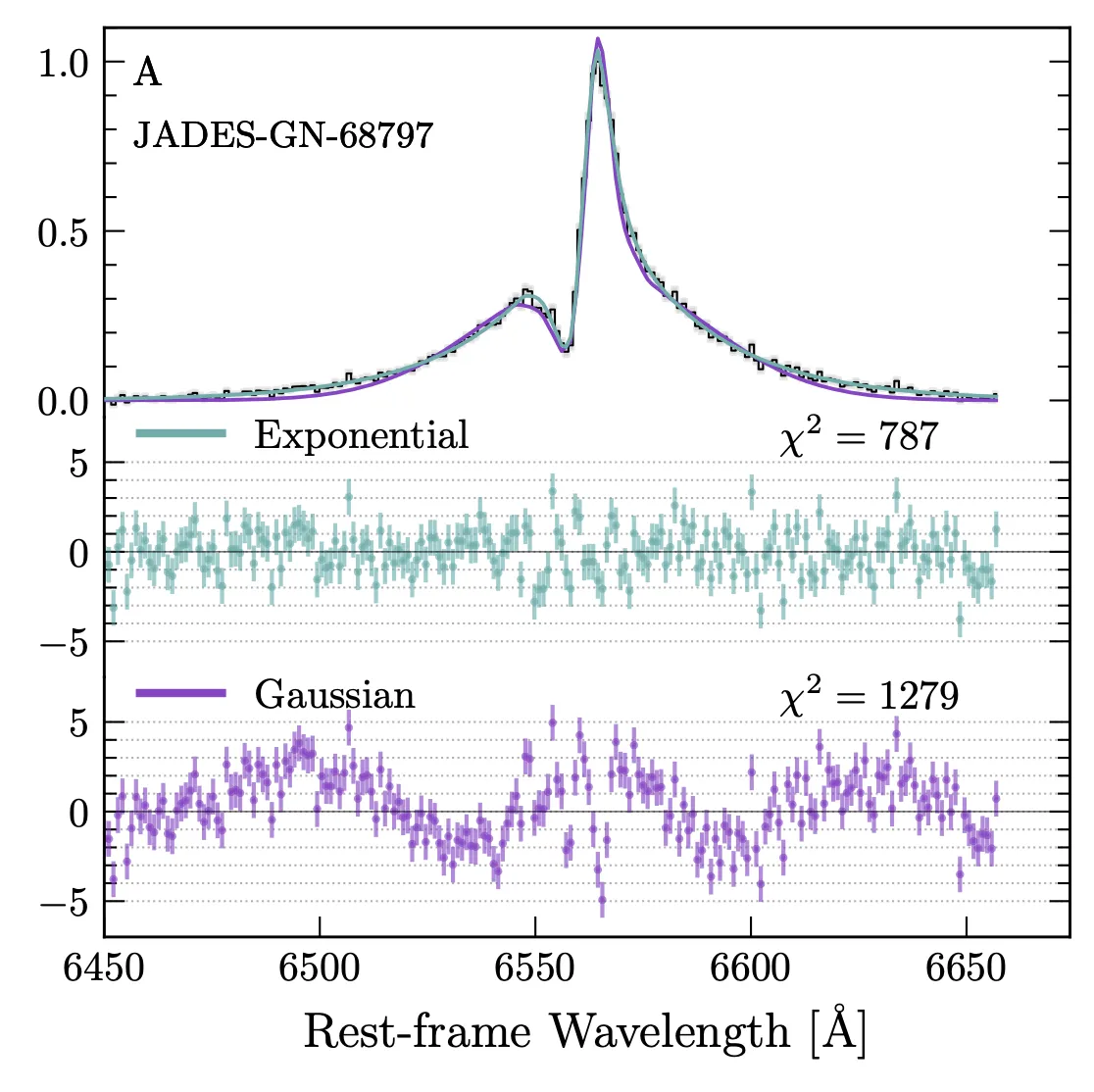 Exponential fit to one of the high S/N little red dot line profiles compiled performed by Rusakov+2025. In my opinion, the money plot of this paper is in the supplementary material—Extended Figure 7, which shows how statistically superior the exponential fits are, compared to Gaussians.
(2) LRDs don’t produce radio emission. If they host accreting black holes, that is weird. We should see at least some of them with some radio emission. But then, if (1) above is correct, it would explain why we should not expect so much radio from these guys.
I think we can pretty much say that LRDs are not just galaxies. So we can move on and focus on the black hole explanation.
<h2 id=theory-tilted-disks-kinetic-multizone-simulations>Theory: tilted disks, kinetic, multizone simulations</h2><p>There has been amazing progress in the theoretical front, particularly in multiscale GRMHD and kinetic simulations. Part of that is due to new algorithms being implemented, particularly in the kinetic case. Who would say that we would be talking about GR-kinetic simulations in the 2020s? But most of the progress is happening, I think, because Moore’s law is allowing us to solve equations with dense meshes that were unthinkable a couple of years ago. Yay, NVIDIA.</p>
There has been important progress in simulating spark gaps in Kerr black hole magnetospheres. We need much more of this if we want to understand how plasma is maintained near event horizons, and how are jets produced (Blandford-Znajek is only part of the story). This is a regime where GRMHD can only take you so far.
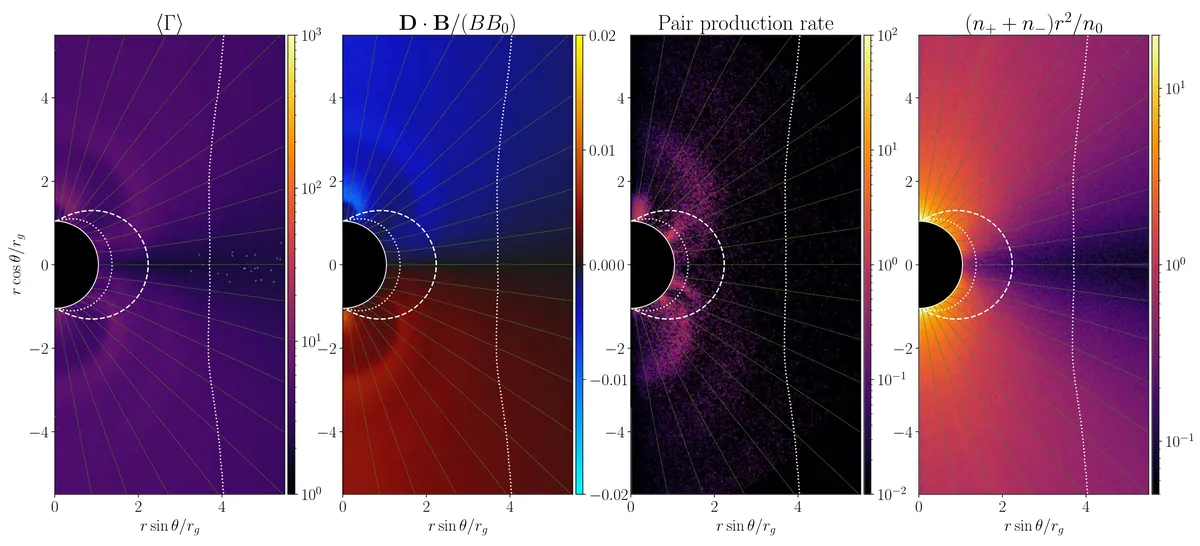 Snapshots showing cross-sectional cuts of several variables from a 2D GR-kinetic simulation. Dashed line is the ergosphere. From Yuan+2025.
We have the impressive work of the H-AMR folks systematically exploring disk tilts and seeing what comes out of it.
And finally, we have the multizone GRMHD simulations bridging the gap from horizon scales up to Bondi radii! Incredible work based on a simple and powerful insight on how to connect boundary conditions by Feng Yuan and collaborators.
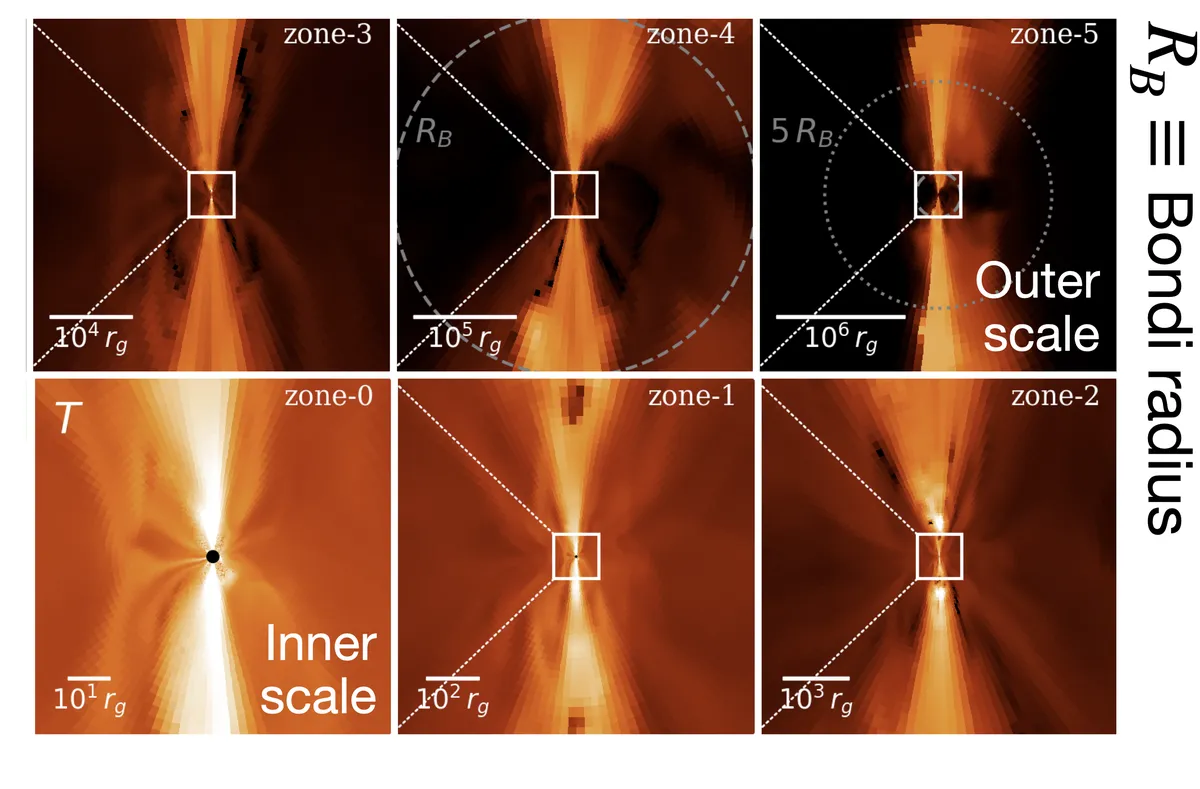 Multizone GRMHD simulation: Feeding and feedback from jets and winds out to (kpc-scale for ). From Cho+2025.
Excited to see what 2026 will bring.
--